

Learn More
Political Perspectives
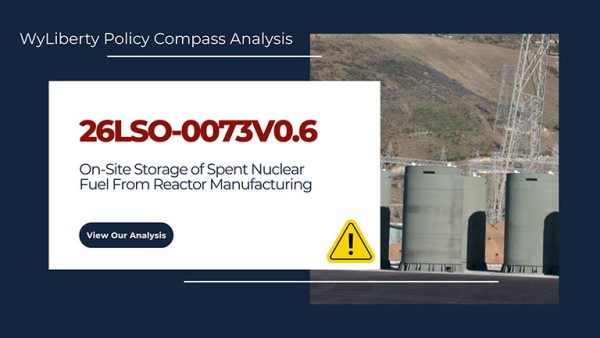
26LSO-0073v0.6: Wyoming Policy Compass Evaluation - On-Site Storage of Spent Nuclear Fuel from Reactor Manufacturing
Summary:
26LSO-0073v0.6 allows nuclear reactor manufacturers in Wyoming to store spent nuclear fuel (SNF) on-site, but only if the fuel is generated as part of the manufacturing process. While the bill attempts to limit what kind of fuel can be stored, the language is vague, allowing the federal Nuclear Regulatory Commission (NRC) regulations to supersede state control in key areas, from licensing to safety.
1. Private Property Rights
Does this policy remove institutional barriers, so that individuals or businesses may more easily use their land, property and labor in ways that do not violate the rights of others?
Result: ❌ Fail
26LSO-0073v0.6 prioritizes the property rights of nuclear manufacturers over the property rights of surrounding landowners. Section 1 of 26LSO-0073v0.6 states that "any spent nuclear fuel in storage at an installation shall remain the property of the advanced nuclear reactor manufacturer until the spent nuclear fuel is transferred to permanent storage or until the United States or a federal agency takes title to the spent nuclear fuel under the federal Nuclear Waste Policy Act." 26LSO-0073v0.6 says nothing regarding the private property rights of landowners adjacent to a potential spent nuclear fuel storage facility. Therefore, this test hinges on the likelihood that the storage of spent fuel could devalue surrounding land, violating these rights. NRC safety standards currently allow the storage of spent nuclear fuel in canisters that can be just a half-inch thick, with a history of concerning challenges.These canisters will also likely remain on-site indefinitely due to the lack of a national repository.
2. Transparent Constitutional Government
Is this policy limited to carrying out the functions of a small and transparent government as described in the U.S. and Wyoming constitutions, while dividing power appropriately between the legislative, executive and judicial branches of Wyoming's government?
Result: ⚠️ Caution
This bill does not require the hiring of additional government workers or create new agencies, consistent with a limited government approach. However, nuclear energy requires the highest degree of emergency planning and long-term environmental monitoring of any energy source, necessitating a larger role for government. Wyoming will bear part of the logistical and political burden, particularly in the case of public push-back or in the event of any mishap involving spent fuel storage. The policy doesn't blatantly expand state government, but it does create a framework for expansion.
3. Responsible Taxation & Spending
Will this policy lower tax intake, reduce government spending, simplify taxation policy and/or broaden the tax base?
Result: ⚠️ Caution
With Wyoming expecting to see a fall in energy tax revenues over the next decade and a half, new revenue sources are key to securing budget stability. 26LSO-0073v0.6fails to remove the tax exemption from HB 74 (2020) for nuclear manufacturers. "No tax shall be imposed on any test or demonstration small modular nuclear reactor licensed."
The federal Price-Anderson Act limits the legal liability of nuclear facilities in the event of an accident, and would presumably cover manufacturers as well. The NRC requires nuclear facilities to insure themselves up to a threshold determined by their risk factor, and will make US taxpayers pick up the tab for an accident exceeding this amount. Insurers and the US taxpayers, but not Wyoming taxpayers, would likely be responsible for the millions/billions in costs of cleanup from a nuclear accident. Even after insurers and the federal government agree to pay, it might prove difficult to recoup these funds in a timely manner, creating uncertainty during state budgeting sessions. Supplemental legislation would be needed to ensure that Wyoming taxpayers are not at risk of higher taxes in the event of an accident.
4. Local and State Control
Will this policy return power to Wyoming families or local governments from state government? Or will this policy transfer power to state government from the federal government?
Result: ❌ Fail
26LSO-0073v0.6 transfers authority from Wyoming to the federal government. Section 1 states, "the criteria upon which the proposed installation site was chosen, and information showing how the site meets the criteria of the Nuclear Regulatory Commission and the department." The site criteria, as with places responsibility with the NRC. Wyoming has no control over safety, storage methods or storage duration of spent fuel. These powers would be transferred to the NRC. In June 2025, the Supreme Court ruled in Nuclear Regulatory Commission v. Texas that state government agencies have extremely limited power to intervene in cases against federal agencies on behalf of residents, meaning federal agencies can ignore local concerns once initial legislative permission has been given. 26LSO-0073v0.6 invites an activity that Wyoming cannot regulate on its own terms, expanding federal involvement within Wyoming's borders.
5. Voluntary Exchange & Individual Choice
Does this policy remove obstacles from business and consumers engaging in voluntary, mutually beneficial transactions, ultimately giving consumers more choices?
Result: ⚠️ Caution
26LSO-0073v0.6 gives reactor manufacturers greater flexibility to operate in Wyoming, by allowing them to store spent fuel on site, thus lowering their storage costs. While the manufacturer receives most of the benefits, the costs are dispersed throughout the surrounding areas. Outside of the legislative process to contact their legislators regarding 26LSO-0073v0.6, neighboring landowners or communities do not have a choice regarding spent fuel storage. That said, 26LSO-0073v0.6 does improve the nuclear-friendly and technologically innovative image of Wyoming (barring an accident), with the potential to increase economic development across many industries.
6. Profit Motive & Fair Competition
Does this policy encourage entrepreneurs and businesses to seek profits through calculated risks, lowering prices for consumers?
Result: ⚠️ Caution
26LSO-0073v0.6 has the potential to help or hurt competition between businesses. Giving nuclear manufacturers the authority to store spent fuel on site reduces their costs, accelerating their road to profitability and an increase in good paying jobs. This increases the chances that Wyoming could become a nuclear business hub that attracts other innovative industries.
That said, legislation targeting a specific industry sets an anti-competitive precedent. It creates the possibility that the industry may pursue ongoing lobbying efforts to receive privileged treatment and/or funding from the state and/or government, if profits fail to meet expectations. Some of the economic viability of the nuclear industry in Wyoming depends on the federal government's blessing, which can change from presidential administration to administration. Nuclear reactor manufacturing could become "too big to fail." Both the federal government and Wyoming's government have already invested significant economic and political capital in the project, and would be very reluctant to let it fail. A government prioritizing fair competition recognizes that all businesses have a chance of failure in an open marketplace. Propping up unsustainable businesses takes away resources from businesses that can profit without government assistance.
7. Honest Elections
Does this policy assist Wyomingites in voting more securely and/or easily for eligible candidates in transparent elections for public office?
Result: N/A
8. Generational Resource Stewardship
Would this policy ensure Wyoming's natural resources can be shared across current and future generations of Wyomingites?
Result: ❌ Fail
26LSO-0073v0.6 improves upon portions of SF186from the 2025 session. However, questions remain. 26LSO-0073v0.6 creates some in-state accountability mechanisms for monitoring nuclear manufacturing facilities. It places Wyoming's Director of the Department of Environmental Quality in charge of ensuring "adequate financial assurance to cover the estimated costs for the decommissioning and reclamation of the installation."
But ultimate authority still rests with the federal government, which has a poorer track record of caring for natural resources than state governments. The NRC is based in Maryland, over1,400 miles away from Wyoming. This makes it difficult for the NRC to consistently monitor nuclear storage facilities and respond quickly if an accident does occur.
Wyoming's land and natural resources become vulnerable if companies cut corners and federal oversight fails. There is also the problem of what to do with the spent fuel, should the nuclear manufacturers leave Wyoming earlier than expected, or the manufacturer goes out of business.
The worst-case scenario is a nuclear accident involving the manufacturing of the modular reactors, or the storage of spent fuel. The best-case scenario is the federal government removing the spent fuel to a permanent repository before the storage casks reach the end of their lifetimes.
The most likely scenario would involve the spent fuel remaining in Wyoming for an unknown number of decades, or centuries. Market conditions change; modular reactors may not prove to be economically profitable as initially foreseen. A new technology could usurp modular reactors' wonder child status, or they could become so popular that another state could offer nuclear manufacturers a subsidy to leave Wyoming. In either event, the spent fuel will likely remain on-site.⚠️
Final Verdict: Caution
Score: 0 Pass | 4 Caution | 3 Fail | 1 Not Applicable
Key Takeaway: 26LSO-0073v0.6 reflects an effort to embrace industrial development—but it does so by inviting an activity Wyoming cannot truly govern, financially or environmentally. While the NRC provides a baseline of safety and oversight, it also limits Wyoming's ability to adapt, enforce, or protect its citizens. The bill fails to meet core free-market and limited-government principles, especially regarding state sovereignty, property rights and environmental protection.
Wyoming Liberty Group
P.O. Box 9 • Burns, WY 82053
Phone: (307) 632-7020
